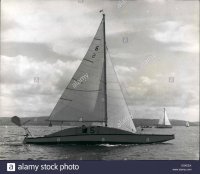
Some people find the new foiling AC boats fascinating. I find them somewhat interesting, as they show what can be accomplished with high technology and gobs of money. They go quite fast, maybe in the high 30s to low 40s in knots. Quite incredible for a mono-hull sailboat.
But Mr. Yrvind's projects fascinate me much more. He seems to be trying to find out how little is needed to make an ocean going sailboat. His boats tend to have little ballast and very short rigs in both aspect ratio and actual sail area.
This probably has as much to do with practicality as foiling monohulls, which can do nothing but go fast, and only in a narrow range of conditions. But it really gets me.
He once crossed the Atlantic with a 15 footer which had only 75 sf of sail. And he did it with two people on board.
Granted, a boat with a ballasted fin keel and a high aspect-ratio rig with generous sail area is certainly faster and arguably more seaworthy. Weatherliness not only wins races, but save one from the clutches of a Lee shore.
But as limited as his boats are in performance, they do have their vertues. I imagine they are easier to maintain, they can sail in shallower water, and probably have much lower hull and rig stresses. Also, on his latest Ex Lex creation, he can easily step its three masts himself, even when it's in the water.
Now, the price he ends up paying for these virtues is the interesting part of the story. Will he make it to New Zeeland? Or will he have to give up, like he had to with the first Ex Lex.
My personal belief is that the original Ex Lex could have been successfully modified, by replacing the two end house structures with a central one, adding another mast and sail, then pushing her harder, which would have meant putting up with a much greater angle of heel.
But the new Ex Lex is certainly a better boat. It's extra Beam, although not that much extra, seems to have greatly improved its stiffness. It can now carry 6 sm of sail or more. But this still gives it a puny S/D of around 6.0, about what one could expect on a more conventional sailboat which is on its 2nd or 3rd reef. Will this be enough?
If it is, I find the practical implications interesting. Perhaps motor sailors can be designed with rigs of this class, and sill go vast distances powered by mostly sail, and be a lot easier to keep and look after.