Modifying a Kayak for Sail

"I agree with you I don't know how they will fare on the water!"

They will be a risk.
You can make them strong enough, if you get 4 lengths of wood the length of the spar, and say about 1.5" square.
Use your router, or a chisel, and make a 1.5" square groove along the length of the spar.

Epoxy the smaller bits of wood into the grooves, and you can be assured of reliable joins.

wood.png


EDit: Heck, you could just run a circular saw twice along the length of the thick spar, and glue in 1/4" marine ply strips about 1.5" deep,
 
Last edited:
Thanks RWatson, I will do as you suggest! The posts are about 3.5 inches, so 1.5 inches might be a bit too deep, but I'll router out the full depth of one of my plunge router bits and clean it up with a chisel. I don't currently have a blade small enough for my circular saw, but that's also a good idea. I don't have any marine ply yet, but I should definitely get some. It seems to be very useful!
 
Thanks RWatson, I will do as you suggest! The posts are about 3.5 inches, so 1.5 inches might be a bit too deep, but I'll router out the full depth of one of my plunge router bits and clean it up with a chisel. I don't currently have a blade small enough for my circular saw, but that's also a good idea. I don't have any marine ply yet, but I should definitely get some. It seems to be very useful!
PS. I could have also suggested Fibreglass oriented along the spars. Even 1/4" of glass and epoxy should be enough.
 
I haven’t reinforced the outrigger posts yet, but I did get to pulling out some spare wood and trying to figure out how to build the outrigger support structure! My thought is to build it with the material you see below, and the design I blocked out (forgive the roughness of it!)

53076619068_d119172700_b.jpg

Here's the rough plan, a triangular support structure that bolts to the top of each post/outrigger at the top, with a second triangular support behind the kayak seat.

53076115801_f1debee61c_b.jpg


Here's the back of the kayak with some lumber laid out. The angled panels will be joined at the top and be supported with a board on the bottom, which will somehow integrate into the cedar boards with the 3 T bolts in them each. What I'm thinking is either cutting them and have the support project forward, or mounting the support right on top of them (probably the structurally soundest). At the bottom of each angled panel, they will connect to the second triangular support, which will then be bolted to the outrigger. I just have to figure out how high off the ground to mount the outriggers so they are in the optimal position in the water! You see here the battery pack for the small electric motor I mounted to the rudder to help get me out of trouble!

53076312514_fee2bb5efe_b.jpg


Here's the board marked up for the new lee boards! They will have a standard lee board shape, slightly tapered, rounded at the top and bottom, with the leading edge slightly shorter than the trailing edge, slightly convex on the inside, more rounded front ways and thinning out towards the back. They'll project about a foot each into the water. I'm planning to bolt them with a single bolt through the outriggers, put a spar at the back of the outriggers, and rig up a bungie cord so the lee boards will bounce back if they hit anything. I thought of rigging up something so I can control their angle, but I can't think of a way to get a rope projecting towards the bow to a position I can control from my seat. I'll have to think a bit more on that. Maybe a pad eye going to a pulley near the bow, then to a cleat on each side? Would it be a problem if I just always left the lee boards down?

Part of me though thinks I may be overbuilding it? Maybe all I need is a straight spar of wood across the back of the kayak, and then a triangular support down to each outrigger, maybe just one, or maybe two, one at the front and back of the cedar boards I have there. That would certainly be simpler! I just worry if it's not designed tough enough, it might break or the force on the lee boards will bend it?
 
You seem to show your lee boards with the grain running in the weakest possible orientation. With the grain running with the length of the board they will not snap as easily to a side load or grounding.
 
Ah yes, you're right! Scratch that, I'll find another board with the right orientation!
 
Thanks Squidly-Diddly and Waterwitch,

For the custom paddle, my concern is how I'm going to attach it to the boat?
make a double ended paddle with flat blades on same plane, and a mid section a hair wider than the boat, and 2 90deg joints so the blades of the paddle fold down. Should be then easy to secure the center section to the deck with straps or clamps. It wouldn't be a very good paddle but should be OK for maneuvering when not sailing.
 
Carlos:

It appears to me that you have leeboards behind your seat. If this is the case, the leeboards are way to far aft. This will give you a terrible lee helm which would make the boat difficult to control.

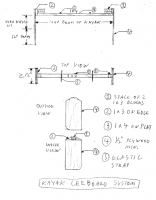
It is allways better to have the leeboards too far forward than to have them too far aft, even if they end up right behind the mast. Attached is a sketch of the leeboard system I mentioned in an earlier post. I recognize that verbal descriptions are often subject to misinterpretation. The system i have designed was not intended to be kept as light as possible, but I don't think it is excessively heavy.

To use it, all you have to do is find a way to center it and get it to sit level on top of your kayak. You might have to use some kind of stand off blocks to get the beam to sit level on top of the kayak. I hope this attached sketch helps.

kayakLeeb.png
 
For ideas on sailing a canoe or kayak, I recommend the Open Canoe Sailing Group | Sailing Adventures http://www.ocsg.org.uk/

I thought it was on the OCSG site that I saw a video of a canoe with leeboard and small sail but no rudder being paddle sailed. The idea was that you can adjust the rake of the leeboard to give a little weather helm and paddle on the weather side to compensate, and when you get tired of that, readjust the leeboard to give a little lee helm and paddle on the lee side to compensate.

With your sail being so small, you have to take the wind pressure on yourself into account to find out the overall centre of effort. I recommend an empirical approach.

Find shallow water, ideally up to the shoulder of someone sitting on the bottom. Tie a bridle to bow and stern, have the person who sits in the water hold the line that is attached to the bridle. Adjust forward and aft legs of bridle so that the boat's angle to the apparent wind is the same as expected when sailing upwind, sheet the sail accordingly. Your helper sights along the line that is attached to the bridle and tells you where a continuation of that line (shown here as a stippled arrow) intersects with the midline of the boat. Marks that spot. It is the centre of effort (CE on the figure) for that course to the apparent wind.

Repeat with the bridle adjusted so that the apparent wind angle is a reach, sheeting the sail accordingly. Again, mark the spot where a continuation of the third line intersects with the midline of the boat. That gives you a range for the centre of effort for courses from on the wind to a reach.

Mount leeboards so that a point one quarter from the leading edge of the leeboards when they are vertical is in the middle of the marked range. Make sure you can easily adjust the rake of the leeboards while sailing. Each leeboard should have a handle on top, and the screw that holds a leeboard to the frame should only be tight enough that you can still rake the leeboard forward or aft.

You may not need two leeboards. One longer board may be better. The slight asymmetry in drag can be compensated for by adjusting rake.
full
 
Thanks all!

Squidly-diddly: I think I get it now. It's sort of what Sharpii2 is suggesting below, but with folding joints. That's a clever idea, I'll have to have a think on how to implement it so I can stiffen the joints as a paddle, or as lee boards. Also, I'll have to figure out how to make the rake adjustable when the boards are bent...

Sharpii2: I think I understand better now, and that looks a lot easier to implement! I'll have to make that, just because it is easy, and because I don't want it too hard to control! Are the elastic straps so you can rake the boards fore and aft? Do you think a wooden mounting block would hold the 1x4 more stable?

Robert: Thanks for that, I often go sailing with some friends, so we should be able to make this work, and the instructions for empirical mounting are very helpful! I still think I'll make Sharpii2's design above, but I'll try to modify the blocks so the board can rake fore and aft. Now, I understand why I would want to rake the lee boards so the end is aft, but I don't understand under what conditions I would rake them so the end is fore? If I use Sharpii2's design, would you pull the windward lee board out of the water or leave it in the water when close hauled?

Yesterday I went sailing on this rig again, and we had a lot of fun! The 1.4 m sail is a bit small, but it gives a nice boost perpendicular to the wind when paddling and if the wind is strong enough, it will pull nicely by itself when you're running. I tried out my Bixpy motor for the first time, and that on the rudder did seem to make upwind a bit easier (The sail has a small bit of pull close hauled, a bit more now that it's helped by the rudder, and of course the motor doesn't hurt!). The rudder also helped perpendicular to the wind.
 
Robert: Thanks for that, I often go sailing with some friends, so we should be able to make this work, and the instructions for empirical mounting are very helpful! I still think I'll make Sharpii2's design above, but I'll try to modify the blocks so the board can rake fore and aft.
This here is a good design for a leeboard for a canoe:
IMG_1519.JPG

This is from Accessories https://www.solwaydory.co.uk/products/accessories/ If you prefer to build, you can probably find instructions online to make something like it. I remember an old article on making wooden daggerboards that emphasised you must pay attention to the orientation of the grain, and recommended gluing together strips with alternating orientation. I don't know whether I still have a copy of that article.

Note the lever on the nut that lets you adjust how tightly the leeboard is screwed down while you sail. Also note that there is only one board, long enough to work when it is on the windward side, provided you don't let the boat heel too much.

Now, I understand why I would want to rake the lee boards so the end is aft, but I don't understand under what conditions I would rake them so the end is fore?

The method I proposed should give you a range for the longitudinal position of the centre of effort, the exact position depending on your course to the wind. If you mount whatever frame holds your leeboard(s) so that the point one quarter from the leading edge (which pretty much corresponds to the location of the screw in the above picture) is in the middle of the range, then to perfectly balance your sail you will sometimes have to swing the board forwards, sometimes aft. And if you want to paddlesail as i described in an earlier post, you will want enough adjustment that you can induce some weather helm (tendency to turn into the wind) or lee helm (tendency to turn away from the wind) on any course, to counter the thrust of your paddle on just one side.

The longer the board, the wider the range over which you can adjust the longitudinal position of the centre of pressure of the board.

If I use Sharpii2's design, would you pull the windward lee board out of the water or leave it in the water when close hauled?
For maximum ability to adjust, I would want a long board, and then you don't need two. The adjustment will take care of the drag being offset to the side a bit.
 
Carlos:

With my proposed system, it is best to leave both leeboards in the water. This insures adequate leeboard area. Such has two side benefits as well. One, both being in the water at the same time help make the boat more stable sailing on a straight line course. Two, the resist snap rolling which can lead to quick capsize.

A deeper board gives better upwind performance. But it also increases the capsize moment. Plus you have to be in deeper water to use it.

You might want to put blocks under the beam so that it rests stably on the deck. These blocks can be attached to the beam. And the need not be wood. They could be foam or some other light material.

Whe looking at the pictures you posted of your kayak, I realized that it may not be possible to place them at the ideal for and aft position. This is because they may then be in the way of your legs. So the may end up right behind the mast. This is not ideal, and you might be able to compensate for this by cutting them so they are raked aft maybe 20 degrees or so. Even then, they will be further forward than ideal. But you do not need ideal. You need workable. And a long, narrow boat, like a kayak provides for a long lever arm for the rudder to fight weather helm. The reason fighting weather helm is superior to fighting lee helm (as would be the case if the leeboards were behind the seat), is that the rudder would be turned at angle (to keep the bow out of the eye of the wind) that would add upwind lift (if it doesn't have to be turned too sharply).

As for the straps. You can have them as long as you like, providing they have enough tension to hold the beam down. This may allow you to scoot the beam forward or aft a few inches.

When not in use, the structure can be flipped upside down (when the sail is down), so they point up. Then you can paddle to suffiently deep water to flip them down. After they are down, you can raise the sail.
 
Thanks Robert and Sharpii2. After my dunking, I feel like I'd prefer to keep the kayak as stable as possible, so I think I'll make Sharpii2's idea! I cut the boards to length, one being just longer than the beam of the kayak is wide, as well as 4 inches by the thickness of the boards (about 3/4 of an inch), and I've glued the two blocks on each end with epoxy according to Sharpii2's diagram. Just have to glue the end blocks on once the epoxy cures, and I can chisel the rough bits out. Now, here's the important bit, the shape of the lee boards! I used my band saw to make a sort of curved block to guide the curves. I left it at 9 inches wide, since that was a good width based on the scrap I had available. Here it is below:

53092716563_584d9039fc_b.jpg


Not sure the shape is quite right. Maybe a bit thinner, say 7 inches? And move the handle a bit forward? And have the taper more like Robert's example above? It doesn't look a lot shorter than that one, but it could be the scale! It's late here anyway, so I'll sleep on it and wait for your opinions before I cut it on the band saw! The line in the middle is the line of the water. Once it's the right shape, I'll also shape it so it is more hydrodynamic.

Robert, I think the article you're referring to is this one?

How to Build Rudders & Centerboards - Epoxyworks https://www.epoxyworks.com/index.php/how-to-build-rudders-centerboards/

Interestingly, the whitewood that I'm using already has the boards in alternating orientation, since it's made for furniture, and that makes furniture stronger. So I already have a bit of a leg up on it, I hope! I'll look for some of those levers at the hardware store, and I'll use them if I can find them!

As for the positioning, I'm still going to try to mount them on the forward rails, so they end up under my legs. That is still comfortable, and it gives me some leeway for moving them, since they can go forward or aft on the rail. I'll try to put some foam or some such support under, to take the stress off the rail, as you suggest Sharpii2!

It may be foolish, but I ordered an optimist sail! I know it's considered a small sail, but it has more than twice the area of my current sail, but fits on a mast and boom that's very similar size to the one I have. The sail I already have is great in strong winds, but in mild winds it leaves a bit to be desired. I feel it will push the centre of effort a bit back, but I'll do the CE testing with both sails to see what kind of measurements I get. I might have to make a second lee board mount for the other sail!
 
Carlos - if you have the Optimist rig on the way, you could consider a second maststep in the stern, which could give you a ketch rig. (smaller sail as the mizzen) Advantages include more power in light airs (you might need substantial outriggers in stronger winds), more control, and it would bring the overall Centre of Effort towards the stern, and make it easier to balance against the Centre of Lateral Resistance provided by the lee board in a more central position. Disadvantages include the possibility of being overpowered and the added complexity of the rig.
 
Thanks Tiny Turnip, that's an interesting idea! I've also thought of trying to make it into a sort of jib! I'll try the optimist alone for now, with the lee boards and the little trolling motor, and see how I get along. There's so many directions you can go with this!
 
Forum posts represent the experience, opinion, and view of individual users. Boat Design Net does not necessarily endorse nor share the view of each individual post.
When making any potentially dangerous or financial decision, always employ and consult appropriate professionals. Your circumstances or experience may be different.

  • Back
    Top