Heeling at speed

Charles Reaves

Junior Member
Joined
Jul 25, 2018
Posts
7
Reaction score
0
Location
Uk
Hi.

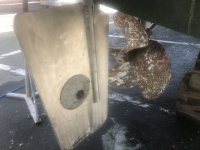
I have a plastik 910 space cruiser, built in Italy. She weighs 6 tons, length 31ft, beam 10.4ft and has twin 230 VMC diesels. She has a deep V flattening towards her stern. Most fuel efficient cruising is at 18knts, but tops out at 28 when fully loaded.When I first got her she had very poor manoeuvrability. At very low speed she was fine using the twin engines, but above 10knots she just would not respond unless I dropped the tab on the inside of the turn, and up to 10knots she would take forever to respond.I was advised to increase the size and change the position of her rudders. They are now 10 inches fore and aft and 17 inches tall, up from 6 and 13, and 2 inches closer to the props. Whilst low speed manoeuvrability has improved, I now find that unless the sea is anything but flat, a beam sea will make her heel significantly, sometimes worryingly so. I can correct this with the tabs but shortly after she heels in the other direction. As far as I can see and check the rudders are parallel and vertical to the hull.I wondered if the larger blades are acting as misplaced hydrofoils or is there something else going on. Any suggestions as to how to cure this would be most welcome.

many thanks in advance
 
I was trying to find details of a Plastik 910 on the internet, but could not find anything - however there is a Plastik 310. Here are a couple of links. Are these similar to your boat?
2004 Custom Plastik SPACE 310 CRUISER, Toscana Italy - boats.com https://www.boats.com/power-boats/2004-custom-plastik-space-310-cruiser-7074770/

Custom Plastik Space 31, 50.000 € | iNautia.it https://www.inautia.it/barca-27019080191610110256491005655101.html

When your boat is turning, does she heel inwards?
I am thinking that if you drop the tab on the inside (rather than the outside) of the turn, then that would resist the inclination to heel inwards (assuming that this is what she does), and hence resist turning?

Re your larger rudders, that is quite a dramatic increase in size! It does sound like they are acting like hydrofoils re heeling the boat.
 
Last edited:
Thanks. She has dual description! 31 ft, or 9.1 metres. ( ignore the maths!) yes, those are images of her sister vessels.

she does indeed heel to the inside rather than turn, hence using the inside tab. Is that normal and to be expected, or part of the problem

if I reduce the rudders, should I reduce height or width first, and if width take it off the front or the back please, and by how much. I would do it by increments of say half an inch at a time. I have attached a photo from just before the stern gear was antifouled
Thank you very much.


Charles

0193DAE0-17A8-4D97-87D2-9C00EC8A95FC.jpeg
 
It is possible the rudders are healing the boat in beam seas, by there being helm applied to counter crosswinds. This would apply if the boat has any combination of a forward position of the centre of lateral air resistance, a rearward position of the centre of lateral water resistance, and a deep vee hull that banks noticeably in turns. I'm not quite understanding what you meant by "shortly after". Are the props counter-rotating ? If not, that could be complicating matters.
 
Are the characteristics of the turn similar when turning to both port and starboard, or can you achieve a 'tighter' turn one way?
Because she heels inwards on a turn (which is normal really), if you drop the inside tab then I think that this will be resisting the heel, and hence helping to resist the inclination to turn? Which then sort of implies that you should drop the outside tab instead? I don't know, just making wild guesses here.
Maybe @baeckmo can shed some light on your problems, and offer some suggestions?
 
If you can ascertain the orientation of the rudders when the problem arises, meaning how much helm is being applied compared to a flat day with no wind, you are well along the way to working it out, this is easily done with outboard boats by just looking back at the engine(s) and seeing which way they are pointing, it is surprising sometimes how far off dead-ahead they are, in crosswinds, and it is otherwise imperceptible almost, if there is no steering feedback and the hull is not inclined to heel much in a turn.
 
It is possible the rudders are healing the boat in beam seas, by there being helm applied to counter crosswinds. This would apply if the boat has any combination of a forward position of the centre of lateral air resistance, a rearward position of the centre of lateral water resistance, and a deep vee hull that banks noticeably in turns. I'm not quite understanding what you meant by "shortly after". Are the props counter-rotating ? If not, that could be complicating matters.
Are the characteristics of the turn similar when turning to both port and starboard, or can you achieve a 'tighter' turn one way?
Because she heels inwards on a turn (which is normal really), if you drop the inside tab then I think that this will be resisting the heel, and hence helping to resist the inclination to turn? Which then sort of implies that you should drop the outside tab instead? I don't know, just making wild guesses here.
Maybe @baeckmo can shed some light on your problems, and offer some suggestions?
Thanks. She has dual description! 31 ft, or 9.1 metres. ( ignore the maths!) yes, those are images of her sister vessels.

she does indeed heel to the inside rather than turn, hence using the inside tab. Is that normal and to be expected, or part of the problem

if I reduce the rudders, should I reduce height or width first, and if width take it off the front or the back please, and by how much. I would do it by increments of say half an inch at a time. I have attached a photo from just before the stern gear was antifouled
Thank you very much.


Thanks again. I will have to check next time I am out, though from memory the outside tab on the turn did not help, and the heeling before the inner tab is dropped can be quite severe. She does have counter rotating props.
T
 
By shortly after correcting the heel, I mean within 30 seconds she heels the other way. If this is a windage problem, then if the wind drops the tab correction will be too much and push her on to the other beam. I am going to have to make list of things to look for when next out.
 
The heeling problem may not have anything to do with the rudders or any assymmetry in the boat. Some boats tend to heel to one side or another when planing above a certain speed. The cause may be that the trim is too low (bow down) and a curved portion of the hull near the bow is immersed.

Here is a previous thread about a similar problem which was eventually solved: Planing Instability https://www.boatdesign.net/threads/planing-instability.48481/

Article in Professional BoatBuilder on the topic: Professional BoatBuilder - 84 - Aug-Sep 2003 https://pbbackissues.advanced-pub.com/?issueID=84&pageID=28 (Back issues of Professional BoatBuilder are available online at Professional BoatBuilder Back Issue Archive https://pbbackissues.advanced-pub.com/ )
 
Another possible cause could be excessive/wrong toe-in or toe-out of the rudders, potentially linked to the separation and reattachment of the flow past the rudder stock. If so changing the toe-in / toe-out of the rudders might solve the problem. Just a guess though.
 
Well, if this problem has only emerged since changing the rudders, it does seem to make them at least part of the issue.
 
Forum posts represent the experience, opinion, and view of individual users. Boat Design Net does not necessarily endorse nor share the view of each individual post.
When making any potentially dangerous or financial decision, always employ and consult appropriate professionals. Your circumstances or experience may be different.

  • Back
    Top